

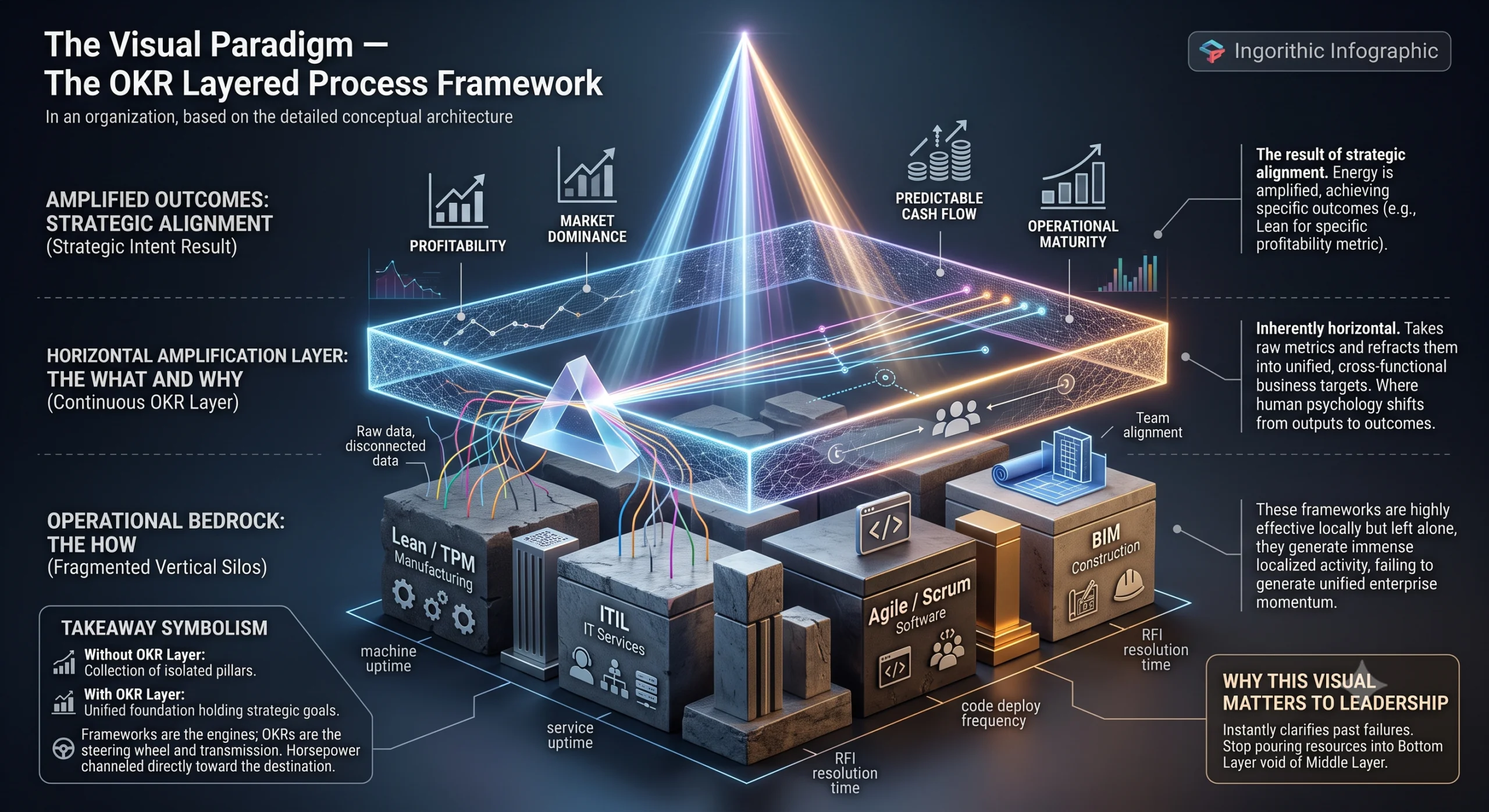
Layered Architecture to Address Strategy to Execution Gap Through OKR
Organizations rarely fail because they lack a solid strategy, and they rarely fail because they lack operational frameworks. They fail because these two layers exist in isolation.
Lately, there has been an excellent push in leadership development to teach executives how to make faster, higher-quality decisions to combat organizational drag. We fully support this focus. But even the sharpest decision-making skills hit a bottleneck if the organization lacks a pre-negotiated context to operate within. When everything is treated as a priority, cognitive overload sets in, and every minor initiative still requires executive arbitration simply because the strategic guardrails are undefined.
To bridge this chasm, we have to stop looking at traditional org charts and start viewing the enterprise as a Layered Process Architecture. In this model, OKRs aren't just another goal-setting exercise—they act as the critical horizontal amplifier that connects your base operational frameworks directly to your strategic outcomes, giving your leaders the context they need to cut through the noise.


